When you sit in my dental chair, we talk a lot about cavities, whitening, and keeping your smile bright. But as a dentist, my concern goes far beyond the aesthetics of your teeth. I often tell my patients: Your mouth is not a separate ecosystem; it is the gateway to the rest of your body.
One of the most critical connections we monitor is the link between Periodontitis (advanced gum disease) and Cardiovascular Health.
It sounds surprising, right? How does a bleeding gum line affect the heart beating in your chest? The answer lies in a complex, microscopic battlefield, and the weapon is inflammation.
The Culprit: Periodontitis
Periodontitis is not just “gums that bleed a little when you floss.” It is a serious, chronic infection that damages the soft tissue and destroys the bone that supports your teeth. It starts with plaque—a sticky film of bacteria. If left untreated, this bacteria hardens into tartar and pushes deep below the gum line.
Here is the frightening reality: If you have moderate to severe gum disease, the total surface area of ulcerated tissue in your mouth can be the size of the palm of your hand.
Imagine having an open wound that size on your arm that is infected and constantly exposed to bacteria. You would rush to the ER. But because it is hidden inside the mouth, many people ignore it.
The Deep Dive: How Gum Disease Travels to the Heart
The connection between your mouth and your heart isn’t accidental; it is biological. Here is the mechanism of how oral bacteria can turn into a cardiovascular risk:
1. The Breach (Bacteremia)
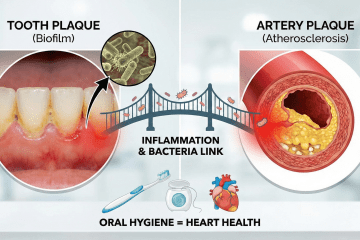
When you chew or brush inflamed gums, the barrier between your mouth and your bloodstream is compromised. Oral bacteria—specifically species like Porphyromonas gingivalis—can enter your blood vessels. This is known as bacteremia.
2. The Inflammation Explosion
Once these bacteria enter the bloodstream, your body perceives an attack. Your immune system responds by releasing inflammatory cells to fight the invaders. This triggers a systemic rise in inflammation markers, such as C-Reactive Protein (CRP).
High levels of CRP are a well-known predictor of heart disease. Essentially, the chronic inflammation in your mouth keeps your body in a constant state of “high alert,” stressing your entire immune system.
3. Clogging the Arteries (Atherosclerosis)
This is where the risk becomes tangible. Oral bacteria have been found inside the fatty plaques that clog arteries (atherosclerosis). The theory is that these bacteria stick to the arterial walls, or the inflammation caused by them damages the blood vessel lining. This encourages plaque buildup, narrowing the arteries and increasing the risk of a heart attack or stroke.
Are You at Risk?
The connection is strong, but the signs are often silent until damage is done. You should schedule a periodontal evaluation immediately if you notice:
- Bleeding gums: Especially during brushing or flossing.
- Persistent bad breath: A sign of active bacterial metabolism.
- Red, swollen, or tender gums.
- Receding gums: Your teeth look “longer” than before.
Protecting Your Heart Starts at the Sink
The good news? This risk is largely preventable and manageable. By controlling the infection in your mouth, you lower the inflammatory burden on your heart.
- Commit to the basics: Brush twice a day for two minutes and floss daily. Flossing is the only way to remove the bacterial colonies between teeth where the brush can’t reach.
- Don’t skip the cleaning: Professional cleanings remove the hardened tartar that harbors bacteria.
- Know your numbers: If you have a family history of heart disease, tell your dentist. Conversely, if you have gum disease, mention it to your cardiologist.
The Bottom Line
Your oral health is a window into your overall wellness. Taking care of your gums isn’t just about saving your teeth—it could quite literally be about saving your life.
If it has been more than six months since your last check-up, or if you are seeing “pink in the sink” when you spit, let’s get you on the schedule. Your heart will thank you.