Tweet:
https://x.com/MoHFW_INDIA/status/2005199890859852050
In a recent national health communication, the Ministry of Health and Family Welfare highlighted the serious risk of misuse and overuse of antibiotics — echoing Prime Minister Narendra Modi’s public call to reduce indiscriminate antibiotic consumption and strengthen rational, doctor-led prescribing.
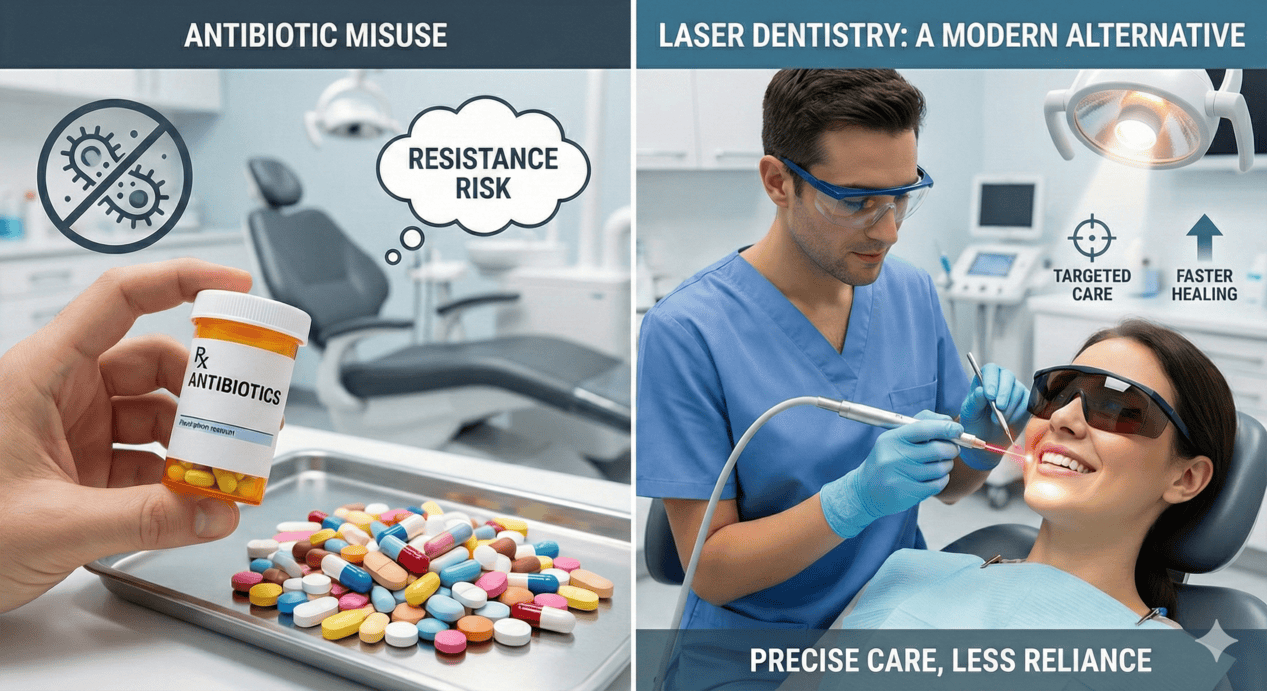
This message is especially important in dentistry, where antibiotics are often prescribed too frequently and without appropriate clinical indications. In contrast, laser-based dental treatments offer a precise, minimally invasive alternative that can reduce reliance on antibiotics and improve patient outcomes.
Lorem ipsum dolor sit amet, consectetur adipiscing elit. Ut elit tellus, luctus nec ullamcorper mattis, pulvinar dapibus leo.
The Growing Problem of Antibiotic Misuse — A Public Health Warning
The indiscriminate use of antibiotics has become a major global health challenge. In India, studies show widespread misuse — including self-medication, inappropriate prescriptions, and use without clinical necessity.
Public health leaders are sounding the alarm:
- Antimicrobial Resistance (AMR): Antibiotics are becoming less effective as bacteria adapt and become resistant. This means common infections may no longer respond to standard treatments.
- Government Action: India has launched updated national action plans to combat AMR across healthcare and community settings.
- Medical Expert Consensus: Top clinicians, including the AIIMS Director, explicitly warn against taking antibiotics without medical supervision because it accelerates resistance and decreases drug efficacy.
This global phenomenon threatens the effectiveness of life-saving antibiotics — not only for dental infections but also for major surgical procedures, immune-compromised patients, and systemic health. Antibiotics should never be viewed as a catch-all for pain, swelling, or infection without a clear clinical indication
Why Antibiotics in Dentistry Must Be Prescribed Carefully
Dentistry accounts for a significant portion of antibiotic use worldwide. Unfortunately, research has shown:
- Over 50% of dental prescriptions may include antibiotics, even when not clinically necessary.
- Many dental prescriptions involve broad-spectrum combinations that are not recommended by the WHO.
- Patient self-medication (without professional guidance) remains common.
Misuse in dental care contributes directly to antibiotic resistance in oral bacteria, meaning routine infections may later require stronger drugs — and in worst-case scenarios, no effective antibiotics.
Antibiotics Are Not Always Needed in Dental Care
Antibiotics should be used in dental practice only when there’s a clear clinical indication, such as:
- Systemic infection confirmed by clinical evaluation
- High-risk patients (e.g., immune-compromised) where prophylaxis is justified
- Spreading infections with systemic symptoms
In most routine dental conditions — tooth decay, localized abscesses, gingivitis, periodontal pockets — the first line of treatment should be targeted clinical procedures, not pills.
Laser Dentistry: A Modern, Targeted Alternative
Laser technology has revolutionized many dental treatments and offers significant advantages that can reduce the need for antibiotics and improve patient safety.
- Precision Treatment with Bactericidal Effect
Laser dental procedures target only diseased tissue while preserving healthy structures. Many laser wavelengths also have a sterilizing effect, killing bacteria during treatment and reducing infection risk.
- Less Invasive, Faster Healing
Laser interventions are minimally invasive — reducing tissue trauma, bleeding, and swelling. Patients often experience faster recovery and reduced discomfort when compared with conventional tools.
- Reduced Anxiety and Reduced Need for Anesthesia
For many procedures, lasers minimize or eliminate the need for injectable anesthesia, making treatments more comfortable for patients with dental anxiety.
- Lower Risk of Post-Operative Infection
Because lasers can cauterize and disinfect simultaneously, the risk of post-treatment infection is reduced — lowering the need for prophylactic antibiotic prescriptions.
- Broad Applications in Dental Practice
Lasers are used for:
- Gum disease (periodontics)
- Soft tissue surgery and lesion removal
- Sterilization during root canal therapy
- Faster healing following surgical procedures
These characteristics make lasers a clinical preference for many dentists, especially in cases where reducing antibiotic use is a priority.
Dentistry and Antibiotic Stewardship: Best Practices
To align with global and national efforts to reduce AMR, dental professionals should:
- Prescribe antibiotics only when clinically justified
- Use guidelines from professional dental associations
- Emphasize precise dental interventions (like lasers) that treat infection at the source
- Educate patients about the limitations and risks of self-medication
Conclusion: Balancing Safety, Efficacy, and Modern Care
Antibiotics have their place in medicine — but they are not a universal cure. Over-reliance without proper diagnosis contributes to resistance, increased complications, and future treatment failures.
As highlighted by national health leaders and echoed by the Prime Minister’s public messaging, medicine — especially antibiotics — requires guidance and clinical oversight.
For dentists, incorporating laser technology where appropriate offers a powerful tool to deliver superior patient care, minimize antibiotic use, and uphold best practices in modern dental medicine.