Dental implants are often hailed as the “gold standard” of tooth replacement, and for good reason. They are durable, aesthetically pleasing, and restore function almost perfectly. Because they are made of titanium and ceramic, there is a common misconception among patients that implants are invincible.
The logic seems sound: Metal and porcelain cannot get cavities, therefore, I don’t need to worry about them.
However, while the implant itself cannot decay, the living tissues supporting it—your gums and jawbone—are very much alive and vulnerable. Today, we need to discuss Peri-implantitis, the primary reason why dental implants are never a “set and forget” solution.
The Anatomy of the Problem
To understand the risk, we must look at how an implant sits in your jaw. Unlike a natural tooth, which is attached to the bone by a periodontal ligament (a shock-absorbing seal), an implant fuses directly to the bone (osseointegration).
Because implants lack that protective ligament, the biological seal of the gums around an implant is slightly weaker than around a natural tooth. This makes the area more susceptible to bacterial invasion if hygiene slips.
What is Peri-implantitis?
Peri-implantitis is an infectious disease that causes inflammation of the gum and the bone structure around a dental implant. It is essentially the implant equivalent of gum disease (periodontitis).
It typically progresses in two stages:
- Peri-implant Mucositis: This is the early warning stage. It involves inflammation of the soft tissue (gums) surrounding the implant. There is no bone loss yet. Crucially, this stage is reversible with improved hygiene and professional cleaning.
- Peri-implantitis: If mucositis is ignored, the inflammation penetrates deeper. The bacteria begin to eat away at the supporting bone. As the bone recedes, the implant loses stability. This stage is not reversible, only manageable.
The Silent Symptoms
One of the most dangerous aspects of peri-implantitis is that it is often painless in the early stages. You might not realize damage is occurring until the bone loss is significant.
Watch for these warning signs:
- Bleeding: Redness or bleeding when brushing or flossing around the implant.
- Tenderness: The gum tissue looks swollen or feels sensitive.
- Discharge: A bad taste or pus coming from the gum line.
- Threads Visible: Seeing the metal threads of the implant (a sign of gum recession).
- Mobility: If the implant feels loose, significant bone loss has likely already occurred.
Why "Good Enough" Hygiene Isn't Enough
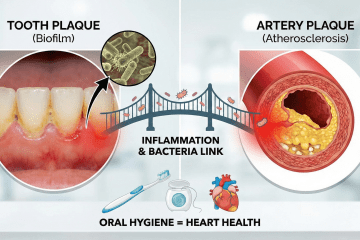
The bacteria that cause this infection thrive in biofilm—a sticky layer of plaque that forms on your teeth and implants. The surface of a dental implant is often microscopically roughened to help it fuse with bone. Unfortunately, if this surface becomes exposed to the mouth, that roughness makes it an ideal breeding ground for bacteria, making it much harder to clean than natural enamel.
Your Protocol for Prevention
Protecting your implant investment requires a specific hygiene routine. Regular brushing is the baseline, not the gold standard.
- Interdental Cleaning is Non-Negotiable Flossing around an implant is different. You often need “super floss” (thick, spongy floss) or interdental brushes to clean the neck of the implant where it meets the gum.
- Water Flossers Many periodontists recommend water flossers for implant patients. The pressurized water can flush out the “pockets” around the implant more effectively than string floss alone, disrupting the bacterial biofilm.
- Professional Maintenance You must maintain your recall appointments. We don’t just “check” the implant; we use specialized titanium-safe instruments to clean it without scratching the surface. We also monitor bone levels via X-rays to catch microscopic changes before they become visible problems.
The Bottom Line
A dental implant is a medical device that requires maintenance, much like a high-performance car. You wouldn’t drive a Ferrari for 10 years without changing the oil. Similarly, you cannot expect an implant to last a lifetime without daily care and professional monitoring.
If you have noticed bleeding around your implant, or if it has been more than six months since your last check-up, please book an appointment. We can often reverse inflammation if we catch it early, ensuring your smile lasts as long as you do.