Why VR might be the best wingman your dentist ever had.
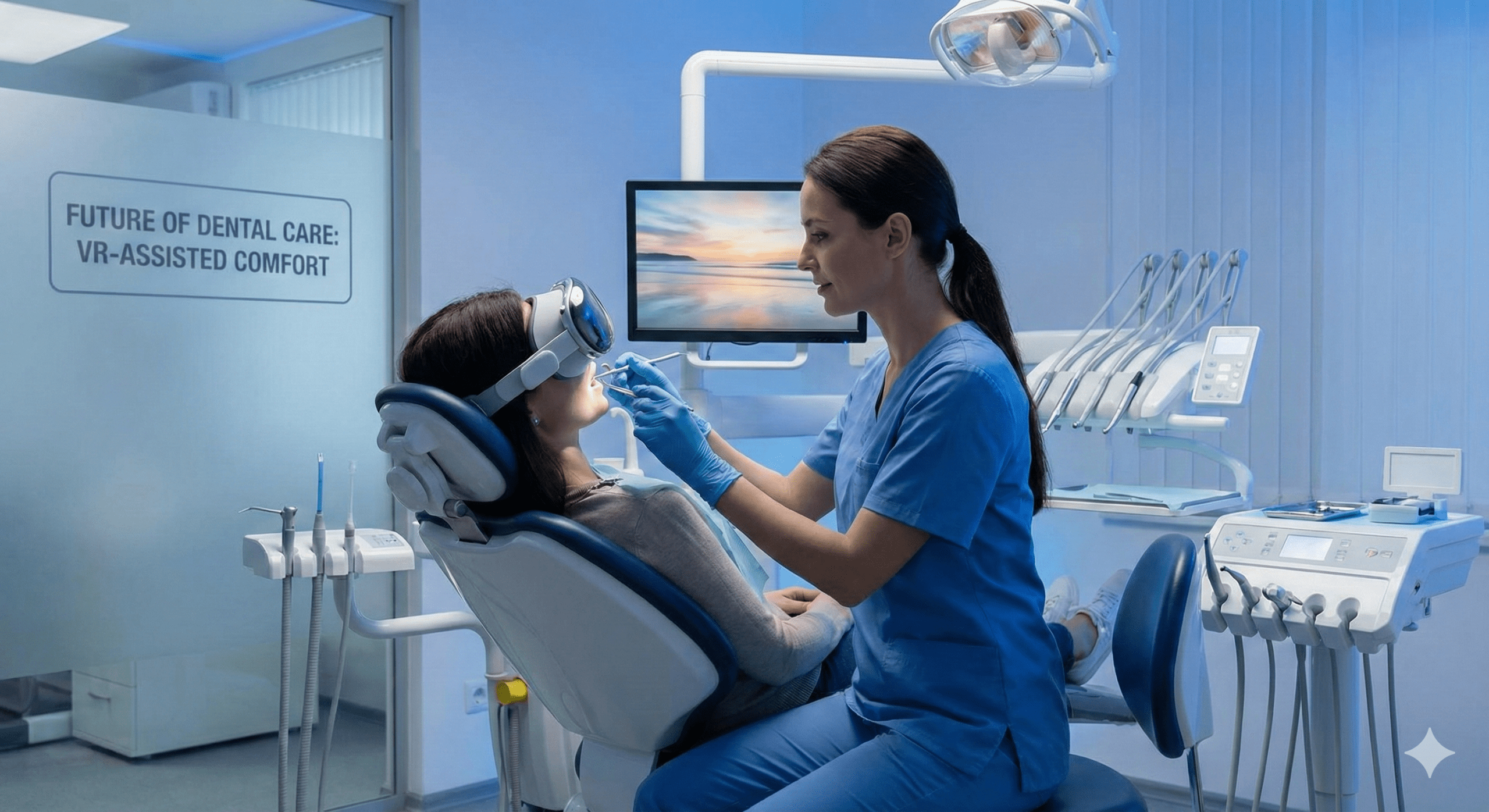
We’ve all been there: the stark waiting room, the distinct smell of eugenol, and that spike of adrenaline when the drill whirs to life. For millions, dental anxiety isn’t just “nervousness”—it’s a barrier to healthcare.
But what if you could trade that clinical ceiling tile for a sunset in Santorini or a meditation garden in Kyoto?
Virtual Reality (VR) is rapidly moving from a gaming novelty to a serious clinical tool. In the dental world, it’s being hailed as “Digital Nitrous“—a drug-free way to hack the brain’s pain pathways. But are we actually close to seeing this in your local clinic, or is it still sci-fi?
The Tech: Hacking the "Gate Control Theory"
It’s not just about distraction; it’s about bandwidth. The human brain has a limited amount of attention it can process at once. VR floods the brain with immersive visual and auditory input, leaving less processing power available for pain signals.
We are already seeing specialized players enter this space:
- OperaVR: One of the leaders in the space, they’ve dubbed their tool “Digital Nitrous.” It’s designed specifically for dental anxiety, offering clinically validated content that claims to lower stress without the grogginess of sedation.
- Magic Horizons: This German company focuses on high-end, medically calming content—think binaural beats and specific color spectrums designed to lower heart rates, not just “cool videos.”
- AppliedVR: While huge in chronic pain management, their “therapeutic VR” protocols are paving the way for acute use cases like root canals or fillings.
The Future: Biofeedback & AI
The current generation of VR is passive—you watch, it plays. The future is reactive.
Imagine a headset equipped with biofeedback sensors (like the Flowborne concept). The system detects your breathing is becoming shallow or your heart rate is spiking as the dentist picks up a tool. Instantly, the VR environment adapts: the virtual sky turns a softer shade of blue, the background music shifts to a down-tempo rhythm, and a guided voice gently coaches you back to a stable breathing pattern.
We are also seeing the rise of AR Smart Glasses (like Keppy), which allow you to watch Netflix or see calm visuals while still seeing the dentist’s face in your peripheral vision—solving the “isolation” panic some patients feel in full VR.
The Reality Check: Why the Dentist is Still the Hero
With all this talk of “immersive worlds,” it’s easy to forget who is actually doing the work.
VR is the wingman; the dentist is the pilot.
Technology can distract the mind, but it cannot diagnose a micro-fracture, navigate complex anatomy, or make the split-second clinical decisions that ensure your safety. A headset can’t comfort you with a reassuring hand on the shoulder, and it certainly can’t build the long-term trust that is the bedrock of medical care.
The goal of VR isn’t to replace the clinical experience but to enable it. By lowering your cortisol levels, VR allows the dentist to work more efficiently and precisely. A calm patient is a safer patient.
Are We Close?
Yes and no.
- The “Yes”: The hardware is here. Headsets like the Meta Quest or Pico are affordable, and software like OperaVR is available now.
- The “No”: It’s not standard yet. Barriers include motion sickness (about 15-20% of users), the “bulk” factor (big headsets can get in the dentist’s way), and hygiene workflows (sterilizing electronics is harder than sterilizing steel).
The Verdict
We are likely 3-5 years away from VR being a “standard menu item” alongside different flavors of polishing paste. Until then, it remains a premium perk for forward-thinking clinics.
The future of dentistry isn’t about removing the human element—it’s about using technology to make the human experience a little less scary.